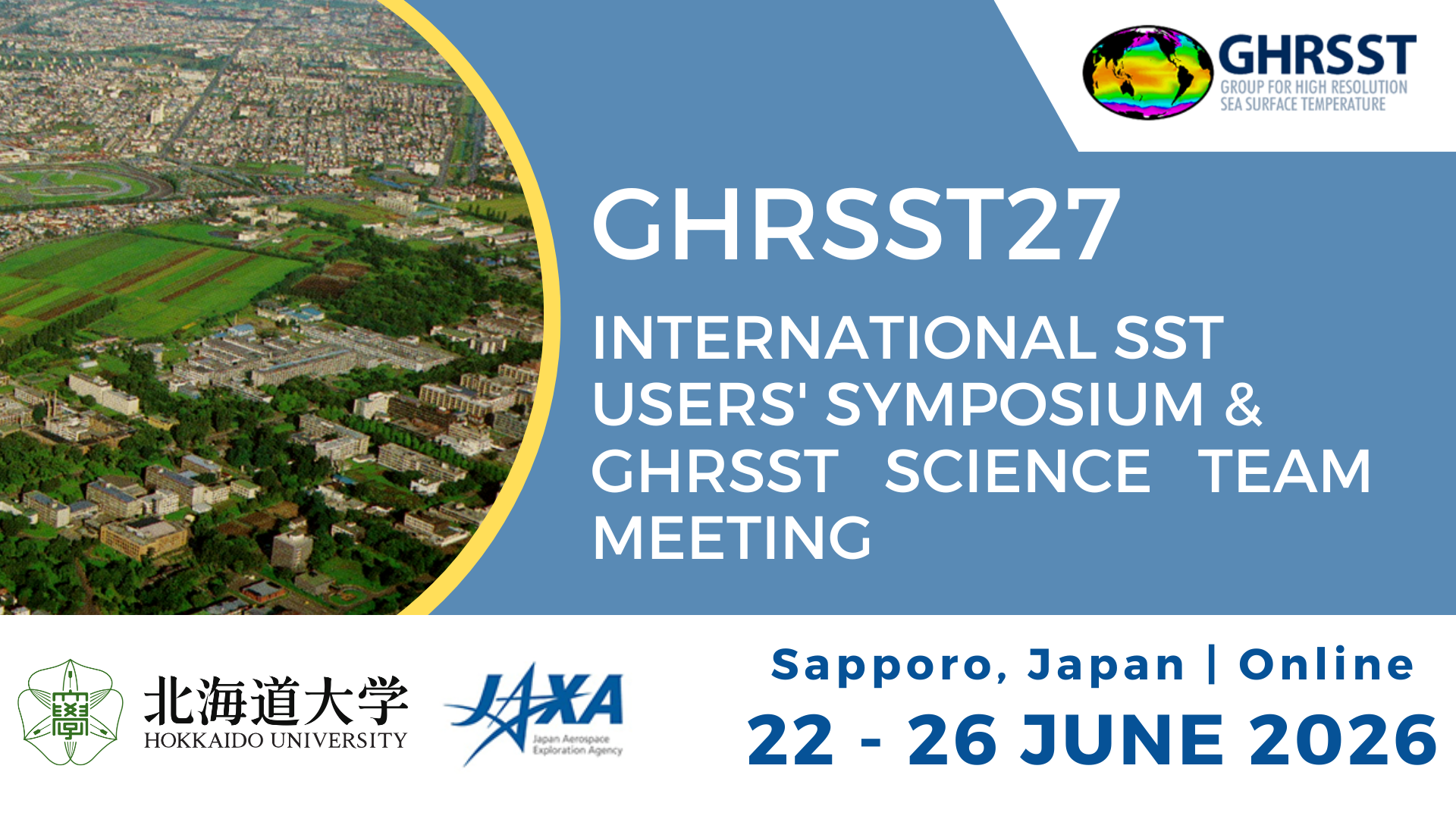
The 27th International SST Users’ Symposium and GHRSST Science Team Meeting (GHRSST27).
GHRSST27 will be hosted by JAXA and Hokkaido University and will take place from 22 – 26 June 2026.
The 27th International SST Users’ Symposium and GHRSST Science Team Meeting (GHRSST27) will take place in Sapporo, Japan from 22 – 26 June 2026 as a virtual and in-person meeting.
In this page we will share the details of the event including meeting session descriptions, registration link, info-pack, templates, book of abstracts and more!
Dates: 22 – 26 June 2026
Target Audience: SST users, SST data producers, SST scientists, early career scientists, students interested in SST
Location: Sapporo, Japan / online
Host: JAXA (Japan Aerospace Exploration Agency) and Hokkaido University

Resources for GHRSST27
Further resources for the meeting, including programme, book of abstracts, templates and guidelines and GHRSST27 info pack will be shared here over the next months. Stay tuned!
Housing information in Sapporo, Japan
In-person participation will take place in Sapporo, Japan. The meeting will be hosted by JAXA and Hokkaido University. The local hosts recommend booking accommodation as soon as possible. In order to facilitate this, the following location and housing information is provided. In case of questions, do not hesitate to contact the GHRSST27 contact points listed at the end of this page.
Science Sessions
Science Session 1: Microwave Sea and Sea-Ice Surface Temperature: algorithm development and operational and research applications
Satellite-borne passive microwave radiometers with C- and X-band are critical resources for global sea surface temperature (SST) and sea-ice surface temperature (SIST) mapping, owing to their unique all-weather observational capability, which infrared sensors lack. The development of algorithms for microwave SST retrievals has progressed over almost three decades and is now indispensable for operational applications such as numerical weather forecast and monitoring of sea state. These efforts are carried forward by the current and future satellite missions such as GOSAT-GW/AMSR3 and CIMR, with increasing demand for their contributions to the generation of climate data records. In addition, new products of SIST from passive microwave are being developed for the new missions.
Emerging challenges—such as quality degradation caused by the increasing Radio Frequency Interferences (RFIs) and the persistent difficulty of accurately capturing low-temperature variability in high-latitudes—have recently drawn significant attention.
This session welcomes contributions addressing recent advances in microwave SST missions, retrieval algorithms, operational utilizations, and case studies demonstrating importance of microwave SST and SIST in applied research.
Focus topics include:
- Current and future passive microwave missions for SST and SIST
- Algorithm development of passive microwave SST and SIST
- Calibration/validation
- Consistency between passive microwave SST and SIST products
- Climate dataset and science applications
- Increasing risks of Radio Frequency Interferences (RFIs)
Keywords: passive microwave radiometer, AMSR, CIMR, operational utilization, climate data record
Science Session 2: Marine Heatwaves
Marine heatwaves (MHWs) are becoming more frequent, more intense, and longer lasting. In fact, the number of marine heatwaves has doubled since 1982, and most recently extreme events have been observed across the world’s oceans. MWHs have profoundly impacted marine ecosystems and habitats over many areas of the world oceans, underscoring the need for improved understanding of their dynamics and predictability. Around Japan, for example, a large meander of the Kuroshio and an extreme northward shift of the Kuroshio Extension caused a significant MHW in 2023-2024, largely damaging the local fishery. Europe also experienced significant marine heatwaves in the North Atlantic in the summer of 2023. Spaceborne SST observations have played an important role in the detection of MHWs. We welcome the latest results on MHWs and their influence on marine ecosystems in the world’s oceans.
The session will focus on:
- Detection, monitoring, and analysis of MHWs
- Modelling and prediction
- Links between MHW and marine ecosystem changes
- Influence on marine ecosystem and global/local climate
Keywords: Marine heat wave, detection, monitoring, modelling, prediction, marine ecosystem, climate
Science Session 3: Sea and Sea-Ice Surface Temperature in coastal and polar regions
Coastal and polar ocean regions present some of the most challenging environments for accurate SST and Sea-Ice Surface Temperature (SIST) estimation. For coastal regions, strong temperature gradients, land influence, river-modified surface layers and rapidly changing surface conditions introduce substantial uncertainty to existing products. In polar regions, cloud screening, the mix of open water and sea ice and the structure of the marginal ice zone (MIZ) add further complexity to temperature estimation.
A major challenge across these regions is the limited availability of in situ observations for validation. Sparse measurements, fast-evolving surface conditions, and transitions between different surface types require strengthened evaluation strategies and improved uncertainty characterization. Approaches may include cross-product comparisons, physical modelling tools, radiative-transfer-based evaluation, machine learning, and other methods suited to data-sparse environments.This session welcomes contributions that advance SST/SIST product quality in coastal and polar ocean regions. This includes also the preparation for higher-resolution thermal missions covering Exclusive Economic Zones. Analytical studies and broader scientific applications—such as investigations of environmental or climate variability in these regions—are also welcome when they relate directly to SST/SIST retrieval or evaluation challenges.
Focus topics include:
- Improving product quality in coastal and polar ocean regions
- Mixed pixels and surface-type transitions (e.g., ocean–land boundaries, MIZ)
- Validation and uncertainty assessment under sparse observational conditions
- Analysis and applications of SST/SIST products in studies of environmental and climate variability in coastal and polar regions
- Preparation for higher-resolution thermal missions covering Exclusive Economic Zones.
- Consistency between SST, SIST and sea ice products
Keywords: coastal SST, polar ocean, SST/SIST retrieval, mixed pixels, surface transitions, MIZ, uncertainty, validation.
Science Session 4: Climate Change, Variability, and Applications in global and regional Sea and Sea-Ice Surface Temperatures
Global and regional climate SST reanalyses and climate data records are essential for monitoring and characterisation of the climate system and its change. Sustained monitoring provides an observational basis for our understanding of climate change and variability, and enables us to place current events into the context of the past. It draws upon information from in situ and satellite observations as well as dynamical reanalyses and climate models. This session aims to highlight the recent advancements in SST and Sea-Ice Surface Temperature (SIST) climate data records and reanalyses with a particular focus on the observed trends, variabilities and the corresponding uncertainties. This session also welcomes contributions on the use of SST and IST products in climate models for assimilation as well as model evaluations. Comparison and validation of climate simulations using different SST/SIST datasets are welcome, in order to provide information to producers to enable them to improve their products for specific applications. Finally, this session welcomes contributions on derived climate indicators and new x-ECV products.
The session will focus on the following:
- Advances in observational climate and reanalysis SST/SIST products
- Applications of SST/SIST observations and reanalyses in global and regional assessments of climate change and variability
- Climate indicators and x-ECVs
- Applications of SST/SIST observations for assimilation, evaluation and inter-comparisons of climate models and dynamical reanalyses.
- Comparison and validation of climate simulations using different datasets
Keywords: Climate monitoring, climate data records and reanalyses, climate change and variability, trends, climate-indicators, dynamical reanalyses, climate model simulations.
Science Session 5: Advances in SST Calibration, Validation, Product Assessments and Uncertainty Quantification
This session aims to highlight recent advancements in sea-surface temperature (SST), with a focus on the calibration and validation of satellite-derived SST products and the assessment of their quality and applicability, particularly on in-situ/FRM datasets and inter-comparisons. Furthermore, a key focus of this session will be on the challenges, methods and advances in quantifying and attributing uncertainties in SST retrievals and products. This involves both the validation of uncertainty information as well as formulation of uncertainties. The session also welcomes discussions on how uncertainties should be presented to product users (such as broken down into uncertainty components, or total uncertainty).
The session will focus on:
- Calibration and inter-calibration of satellite instruments.
- Validation of satellite-derived SST products.
- Comparisons between satellite data products and in situ measurements.
- Inter-comparisons of satellite products from various platforms and sensors.
- Quality control and quality assurance of satellite data products.
- Uncertainty quantification in SST retrievals and products: validation of uncertainty information and formulation of uncertainties.
Keywords: Calibration, intercalibration, validation, product assessment, inter-comparison, quality control, quality assurance, uncertainties, evaluation, error sources
Science Session 6: Satellite-based SST for operational Numerical Weather Prediction, ocean modelling, reanalysis and climate models
Numerical Weather Prediction (NWP) and Ocean modelling systems are essential for predicting the state of the atmosphere and ocean, while coupled ocean-ice-atmosphere models have been largely used for many years, already demonstrating a significant improvement in the forecast quality with respect to uncoupled systems. The Near-Real-Time (NRT) operational production and availability of SST data is essential for the support of NWP and ocean modelling systems, in particular for the coastal regions. This session aims at highlighting the applicability of satellite-based SSTs for operational NWP and ocean modelling, coupled or uncoupled and including data assimilation, as well as reanalysis systems and climate models. Contributions on the use of SST products in climate models for assimilation as well as model evaluations, i.e. comparison and validation of climate simulations using different SST datasets are welcome, in order to provide information to producers to enable them to improve their products for specific applications.
Presentations on a wide range of topics, from NRT production and applications of SST data, observation operators for SST, direct assimilation of L1 satellite data, status of the operational systems and applications, ocean heat content and climate modelling are welcome.
The session will focus on:
- Applications of NRT SST products for NWP and Ocean Modelling, including coastal ocean modelling in Japanese waters
- Applications of direct data assimilation, observation operators
- Advances and challenges in coupled data assimilation systems for operational applications, reanalyses, and climate models
Keywords: NWP, Coastal ocean modelling, Reanalyses, data assimilation, observation operators, climate modelling
Science Session 7: Advances in Computing: Artificial Intelligence and cloud computing for SST observations and products
This session is dedicated to new and evolving approaches of computing techniques for GHRSST data product formulation, validation and scientific investigation. Results using methodology and workflows applying Artificial Intelligence and Machine Learning for SST products and analysis are encouraged. This session will also emphasize cloud computing and storage, optimization of formats and processing software for the cloud, and parallel computation approaches. Furthermore, this session welcomes contributions regarding AI applications using satellite SST observations, including new methods, best practices, or links to the GHRSST Data Specification Document (GDS).
The session will focus on the following:
- Challenges and advances in various computing techniques
- Artificial Intelligence and machine learning applications
- Challenges and advances of cloud computing and storage technologies
Keywords: Computing, parallel computing, cloud computing, cloud storage, data formats, SST products and validation, Artificial Intelligence, Machine Learning
GHRSST27 Contact
For general questions, please contact the following persons:
- Irene Robles Garcia irga[at]dmi.dk
- GHRSST Project Office: gpc@ghrsst.org